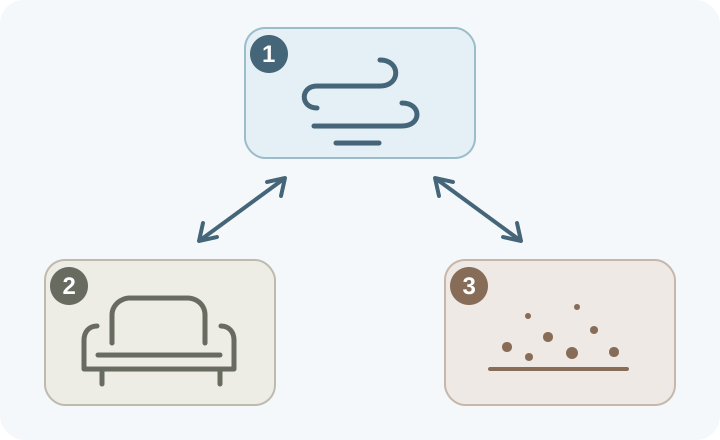
Conceptual relationship map based on the reservoir explanation in the cleaning study. Arrows show possible deposition and return to air, not measured rates, equal amounts or a recovery sequence.
- 1 · Air
Gases can be released again; particles can become airborne again.
- 2 · Surfaces and materials
Deposits can remain on surfaces or within porous materials.
- 3 · Settled dust
Dust can hold residues and contribute to exposure through different routes.
Air, surface and dust measurements answer different questions
Air is not the room's only storage space. Smoke constituents can attach to a surface or enter porous materials such as upholstery; settled dust is another reservoir. Some chemicals can later be released as gases, and settled particles can become airborne again. Inhalation, contact with skin and ingestion are different possible exposure routes. The illustration shows these relationships, not how much moves in a particular home.
The public abstract of a September 2026 review describes indoor field measurements and laboratory research, including nicotine in air, dust and surfaces. Its proposed nicotine thresholds classify indoor environments; a contamination category is not a human safety limit. This page does not use those thresholds to certify a room or estimate a person's health risk.
A change in one compartment need not match another
The San Diego household study published in the 2017 issue measured homes after the resident smoker stopped and indoor smoking was prohibited. Some surface nicotine values fell early, while dust pollution did not show the same clear decline. The later groups were very small, and exposure elsewhere was not fully excluded. This supports separating compartments—not saying residues never decrease or that every home follows one six-month curve.
Stopping the new source remains important. Opening a window or running a purifier does not replace a smoke-free interior, and continuing to smoke would add new pollutants rather than resolve the old ones. Neither visible cleanliness nor the disappearance of an odour establishes that all substances have gone.
Cleaning has been studied—but not as a safety guarantee
A study published online in 2020, in the 2021 journal issue, used professional cleaning in low-income multiunit apartments with indoor smoking bans and detected residues. Homes were assigned different orders of dry/damp and wet cleaning, or both together. Surface nicotine fell after the combined efforts and remained lower at three months. The amount of nicotine in dust per floor area fell initially but rebounded; nicotine per gram of dust was a different measure and did not show the same overall change.
All groups eventually received both methods, and the overall before/after result pooled them; it was not a comparison with an untreated group. Groups were small and differed in surface nicotine at baseline. Only selected nicotine measures were assessed, not every pollutant, resident health or a personal safe level. Remaining reservoirs are a plausible explanation for replenishment, but new smoke entering could not be fully ruled out. The findings do not validate a universal household recipe or number of cleanings.
A room inventory is more useful than a countdown
For a fictional former smoking room, distinguish three things when asking about the environment: whether fresh smoke still enters; which materials may hold older deposits, such as curtains, upholstery and carpets; and whether the proposed work concerns surface cleaning or deeper material assessment. This is a set of questions for a qualified building or environmental professional—not an instruction to remove walls, mix chemicals or reproduce a research protocol. Follow material and product safety instructions; discuss rented-property work with the responsible housing service.
Ask what a test actually measures and what a provider means by ‘clean’. A reduction in one marker is not proof of zero exposure or a percentage reduction in disease risk. Qualified healthcare is appropriate for symptoms; in England, NHS Stop Smoking Services offer a separate official route for cessation support. No room history, photographs, test values or health information need to be submitted to this site.
What to keep in mind
Sources
The central claims on this page were checked against the sources below.
- Nicotine & Tobacco Research / University of California repository: Matt et al. (2021; online 2020): cleaning interventions and persistent thirdhand-smoke reservoirs
Sources checked: 2026-10-06
- Tobacco Control: Matt et al. (2017; online 2016): household residues after cessation
Sources checked: 2026-10-06
- ACS ES&T Air: Thirdhand Tobacco Smoke (2026): public abstract of indoor field and laboratory review
Sources checked: 2026-10-06
- Centers for Disease Control and Prevention: Preventing secondhand-smoke exposure in the home
Sources checked: 2026-10-06
- NHS Better Health: England: local Stop Smoking Services
Sources checked: 2026-10-06
General environmental evidence, not a remediation protocol, personal exposure estimate, medical advice or certification that a property is safe.