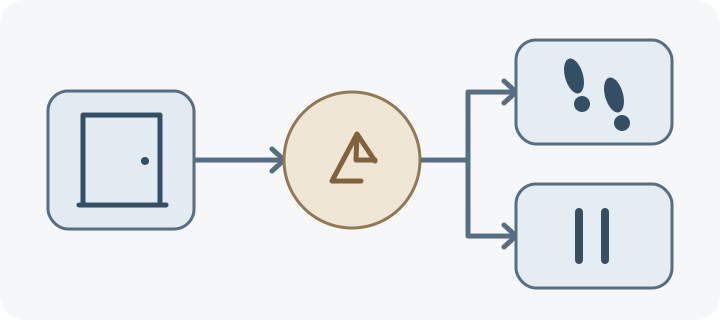
Conceptual illustration, not study data, a treatment sequence or a prediction. The branches show that a prompted impulse and completed action must be distinguished, not that outcomes have equal probabilities.
- Doorway · cue
A familiar situation can be linked with an action through repetition.
- Central symbol · impulse
A prompted tendency can arise with little deliberation; urge intensity is a different question.
- Footprints and pause · distinct outcomes
Beginning or withholding an action is not determined by the impulse alone.
Reaching for something and wanting it are different observations
A fictional example: after ending a familiar phone call, someone starts reaching towards the place where a cigarette pack used to sit, then notices the movement. They do not recall a strong urge beforehand. This illustrates an action beginning with little deliberation; it does not establish what caused that person's movement or diagnose a habit.
‘How strong was the urge?’ concerns a subjective experience. ‘How did the action start?’ concerns initiation. A weak urge report cannot by itself show that no learned response exists, and an automatic start does not prove that the whole sequence runs without awareness. Frequency alone is also not a measure of automaticity.
The smoking evidence is more specific than ‘the brain takes over’
Orbell and Verplanken's 2010 paper used a self-report habit index in three studies. One linked scores with smoking-word interference in a Stroop task. Another prospective study linked habitual smoking while drinking in pubs with cigarette-related action slips two months after indoor pub smoking became illegal. The third study involved dental flossing, not another smoking experiment.
Those findings support studying cue-linked automaticity beyond how often someone smokes. They do not directly establish that people had no craving during the slips, or that every slip meant a completed cigarette. The attention task and later reports of action slips are different measures; neither is a personal test of lost control.
A prompted impulse is not an inevitable outcome
Gardner's review distinguishes a habit-generated impulse from the behavior itself. A familiar cue may make an action more readily available, while goals, other impulses and inhibition also influence what happens. This distinction explains why a response can feel easy to start without claiming it is impossible to interrupt.
The review also warns that much health-habit evidence is correlational and based on self-report. Inferring ‘I must have acted without awareness’ after an event is not direct observation of every mental process. Nor does this general model prove that noticing a movement alone prevents future smoking or identify a treatment for an individual.
Describe the sequence without assigning yourself a label
‘I noticed my hand starting towards the old pack location after a call’ is a concrete description for a conversation with qualified support. It need not become ‘I have no control’ or ‘there was no urge, so dependence is irrelevant’. NCI describes routine and situational reminders alongside nicotine-related craving; these are not mutually exclusive explanations. There is no invitation here to smoke or expose yourself to cues to find out which applies.
In England, NHS Better Health links to local stop-smoking support. Ask about access and the assistance offered; elsewhere use a relevant local health service. This page offers no habit score and does not ask you to submit your movements, smoking history or private situations.
What to keep in mind
Sources
The central claims on this page were checked against the sources below.
- Orbell and Verplanken · Health Psychology / University of Essex: The automatic component of habit in health behavior: habit as cue-contingent automaticity (2010)
Sources checked: 2026-10-06
- Gardner · Health Psychology Review: A review and analysis of the use of habit in understanding, predicting and influencing health-related behaviour (2015)
Sources checked: 2026-10-06
- National Cancer Institute: Handling nicotine withdrawal and triggers
Sources checked: 2026-10-06
- NHS Better Health: Ready to quit smoking
Sources checked: 2026-10-06
General learning education, not a diagnosis, habit score, craving interpretation, cue-exposure exercise or personal treatment recommendation.