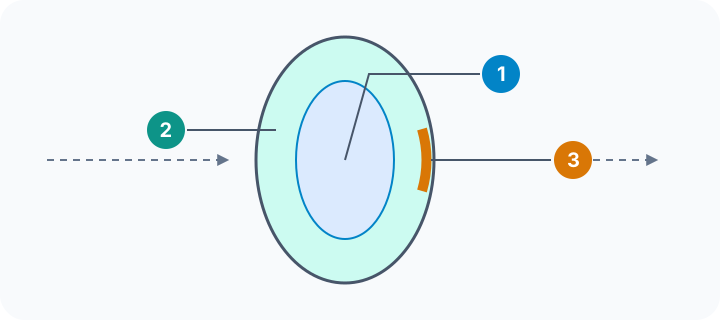
Location map, not to scale or a diagnostic image. These are not three stages or measured smoking effects.
- 1 · Nuclear
Central lens region.
- 2 · Cortical
Outer lens layer.
- 3 · Posterior subcapsular
Just inside the back lens capsule, not in the retina.
How a transparent lens loses optical clarity
The lens sits behind the iris and pupil, helping focus light onto the retina. Its proteins normally have an arrangement that permits transparency. Changes and clumping can make light pass less clearly, producing haze, altered colour or glare. This differs from damage in the macula of the retina.
Age is a major part of the background; diabetes, injuries, some medicines and other exposures also matter. Risk-factor education is not a reason to stop a prescribed medicine. Blurred sight has several possible causes, so neither a history of smoking nor a familiar description establishes cataract.
Three locations, not three equally proven smoking effects
Nuclear cataract concerns the lens centre; cortical cataract concerns its outer layer; posterior subcapsular cataract lies near the back, beneath the capsule surrounding the lens. More than one location can be involved. The back of the lens is still not the retina at the back of the eye.
The 2004 US Surgeon General review concluded that smoking causes nuclear cataract; CDC’s 2011 research introduction explicitly records that conclusion. This is an established historical review, not a new 2026 grading. It cannot be widened to an identical causal conclusion or effect size for every cataract subtype. Different definitions of ‘any cataract’ may combine quite different changes.
Why a diagnosis and an operation count are different
Imagine two headlines: ‘fewer new lens opacities’ and ‘fewer cataract operations’. One describes a lens finding; the other describes an intervention. Operations also depend on clinical needs and access to care. Fewer procedures do not by themselves demonstrate that cloudy lenses became clear. The CDC paper’s own visual-impairment results were cross-sectional and self-reported, not a trial showing that quitting reversed cataract.
An appropriately qualified eye-care professional can explain which lens area is involved and how much of the visual difficulty is attributable to it rather than another eye problem. The practical distinction is between reducing future exposure and assessing an existing opacity. Qualified local cessation support helps with the former; it does not choose the timing of an operation or an artificial lens. Those personal decisions belong to clinical care.
What to keep in mind
Sources
The central claims on this page were checked against the sources below.
- US National Eye Institute: Cataract as lens opacity, protein changes and multiple risk factors; updated 19 August 2026
Sources checked: 2026-10-10
- Centers for Disease Control and Prevention / Preventing Chronic Disease: CDC-hosted 2011 primary research: introduction explicitly identifies the 2004 Surgeon General nuclear-cataract causal conclusion; its own survey is cross-sectional
Sources checked: 2026-10-10
- Bundesgesundheitsportal / IQWiG: Kern-, Rinden- und hintere subkapsuläre Katarakt: Lage der Linsentrübung und fachliche Abklärung
Sources checked: 2026-10-10
- Assurance Maladie / ameli.fr: Cristallin, opacification, vieillissement et tabagisme; 22 janvier 2026
Sources checked: 2026-10-10
Population education, not personal diagnosis, home testing, medicine changes, screening decisions, surgery timing or lens-selection advice.