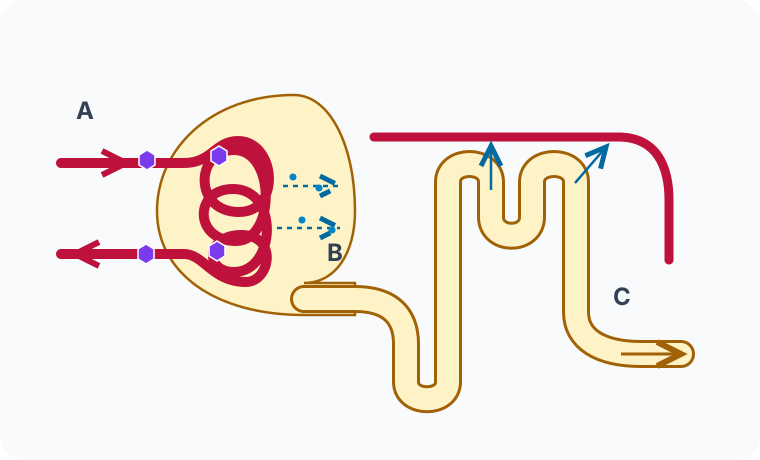
Original, simplified normal-function schematic. Colours and symbols are not concentrations, eGFR values, disease stages or a diagram of smoke blocking the kidney.
- A — Blood and retained proteins
Larger proteins normally remain in the glomerular blood vessels.
- B — Filtered fluid
Water and small molecules enter the tubule; this is distinct from protein leakage.
- C — Return and remaining fluid
The tubule returns needed substances to blood; what remains proceeds toward urine.
Four studies, four different questions
Actual designs, simplified without individual test cutoffs or effect estimates. Entry conditions are not instructions for readers to test themselves.
| Study | Starting population | Recorded outcome | Do not substitute |
|---|---|---|---|
| UK Biobank, 2026 | No CKD at study entry | New CKD in clinical records | A continuously measured filtration trajectory |
| Jackson Heart Study, 2016 | Participants with measurements at two visits; dialysis excluded | Change in estimated filtration | New CKD or kidney failure |
| Korean NHIS, 2019 | No ESKD at entry; some had CKD | New code-identified ESKD | Every earlier stage of kidney disease |
| CRIC, 2018 | Existing CKD | Kidney progression, death and their combined outcome | The combined result for kidney progression alone |
A kidney filters blood while keeping useful proteins in circulation
Each nephron contains a glomerulus, a cluster of tiny blood vessels, and a tubule. Water and small molecules enter the filtered fluid; larger proteins and blood cells normally stay in the blood. The tubule returns needed water and substances to circulation, and the remaining fluid becomes urine. The illustration shows these functions, not smoke particles blocking a filter.
Albumin is a blood protein, so its passage into urine concerns a different function from the amount of blood being filtered. Creatinine, a product of muscle metabolism, can be used to estimate filtration—the ‘e’ in eGFR means estimated. Neither measure by itself reveals how much injury smoking caused.
Biological routes are plausible; the follow-up does not measure every route
The kidney depends on its blood supply and on the behaviour of small vessels. The kidney literature discusses impaired vessel-lining signals, oxidative stress and inflammatory processes linked to smoke. Diabetes and high blood pressure also relate to kidney disease, so pathways and background conditions can overlap rather than form one isolated chain.
Jackson Heart Study investigators found an association with a later fall in estimated filtration and discussed inflammation as a possible contributor. That does not prove that inflammation alone caused the change. The 2026 UK Biobank paper likewise discusses mechanisms from earlier research; its own outcome came from clinical records, not direct observation of every participant’s kidney cells.
The starting population changes what ‘kidney risk’ means
The 2026 UK Biobank analysis began with people without CKD and recorded new CKD diagnoses. In the primary analysis of 191,774 participants, former smokers and follow-up quitters were compared with current smokers; nonsmokers served as a reference in secondary analyses. Jackson instead compared current smokers with the study’s never-smoking group while following estimated filtration between two visits in 3,648 participants; excluding dialysis did not exclude everyone with CKD.
The Korean study followed people without end-stage kidney disease, including some with CKD, and identified new ESKD through insurance diagnosis and medical-aid codes. These are different starting points and outcomes. The comparison chart preserves them rather than combining their estimates into a single ‘kidney damage’ percentage.
A combined outcome can produce a misleading headline
In the CRIC study, 3,939 people already had CKD. Progression meant major loss of estimated filtration or dialysis/transplantation; death was also studied separately and in a combined progression-or-death outcome. Persistent smoking was associated with higher all-cause mortality than not smoking during follow-up—not necessarily lifelong never-smoking—but the adjusted estimate for kidney progression alone did not show a clear increase. Calling the combined result ‘faster kidney progression’ would change the finding.
This does not demonstrate that smoking is harmless. Exposure was self-reported, relatively few participants reported persistent use, and time-updated exposure did not guarantee strict ordering of every filtration change. Elsewhere, baseline-only smoking, missing follow-up questionnaires, record-based case detection and population differences also constrain conclusions. A large sample does not remove these limitations.
What the evidence helps you understand—and what needs a clinician
When a headline says ‘smoking harms the kidneys’, ask what changed, who was included at the start and what group was used for comparison. Urinary protein is not kidney failure; newly recorded CKD is not the course of an existing disease; death is not a filtration measurement. The paper’s outcome must survive the retelling.
Personal results and kidney-care questions belong to qualified services where you live. The NHS resource here concerns GP access in England, not worldwide English-language care. This page provides no test thresholds, screening timetable, medication changes or fluid and nutrition plan. Stopping-smoking support does not replace kidney care, and these observational results provide no guaranteed recovery date.
What to keep in mind
Sources
The central claims on this page were checked against the sources below.
- National Institute of Diabetes and Digestive and Kidney Diseases, United States: Your Kidneys & How They Work — last reviewed June 2018
Sources checked: 2026-10-02
- National Institute of Diabetes and Digestive and Kidney Diseases, United States: Chronic Kidney Disease Tests & Diagnosis — last reviewed October 2016
Sources checked: 2026-10-02
- Kidney Medicine / PubMed Central: Association of Smoking, Smoking Cessation, and Genetic Susceptibility With Chronic Kidney Disease Risk — Kidney Medicine, 2026-05-14; DOI 10.1016/j.xkme.2026.101408
Sources checked: 2026-10-02
- Journal of the American Heart Association / PubMed Central: Cigarette Smoking and Chronic Kidney Disease in African Americans in the Jackson Heart Study — 2016; DOI 10.1161/JAHA.116.003280
Sources checked: 2026-10-02
- Scientific Reports / PubMed Central: Smoking and risk of incident end-stage kidney disease in general population: A Nationwide Population-based Cohort Study from Korea — 2019
Sources checked: 2026-10-02
- Clinical Journal of the American Society of Nephrology / PubMed Central: Self-Reported Tobacco, Alcohol, and Illicit Drug Use and Progression of Chronic Kidney Disease — 2018; DOI 10.2215/CJN.11121017
Sources checked: 2026-10-02
- NHS, England: Register with a GP surgery — last reviewed 2025-07-28
Sources checked: 2026-10-02
Population-level kidney education, not personal risk prediction, laboratory interpretation, testing instructions or kidney-disease management. No treatment or recovery promise.