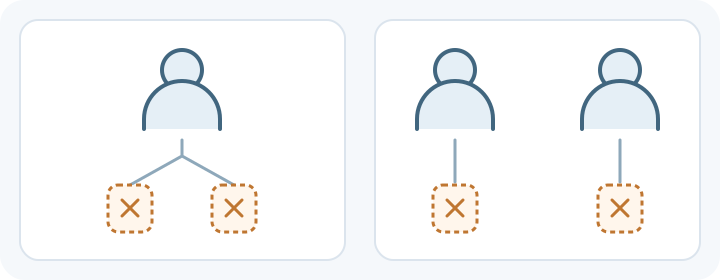
Invented counting example, not study data or an illustration of a clinical condition. The markers stand for lost teeth, not disease severity.
- One person loses two teeth
Two teeth lost; one person affected.
- Two people lose one tooth each
Two teeth lost; two people affected. A person-based percentage cannot be read as a tooth count.
A missing-tooth total cannot date the loss
‘Incident tooth loss’ asks about teeth lost during follow-up. A survey of existing missing teeth measures accumulated loss instead: some teeth may have been lost before smoking stopped. Edentulism means no natural teeth remain; it is not the same outcome as one newly lost tooth or losing six or more teeth.
The counting example separates teeth from people. Tooth-based studies also need to account for several teeth belonging to one person. A risk ratio (RR) compares observed outcome risks between groups; it is not a number of teeth saved, nor an absolute percentage-point change for an individual.
An older reassuring summary is not the last word
The 2019 cessation review's longitudinal synthesis reported former-versus-never smoking RR 1.15 (95% confidence interval 0.98–1.35), with substantial differences between studies. An interval containing 1 leaves a statistical difference uncertain; it does not establish equivalence. The review also mixed definitions of tooth loss, assessment methods and when people were classified as having quit.
A 2026 review found past-smoking RR 1.21 (1.07–1.37), from only two cohorts, versus never or non-smoking as defined in those studies. Its current-smoking synthesis used five cohorts, not the same two-group quitting experiment. The evidence was rated very low certainty. Different selection rules, outcomes and statistical transformations help explain why review summaries differ; do not divide their estimates to calculate a personal benefit from quitting.
The newer review converted some ORs and HRs to RRs approximately and noted potential reuse of comparison groups when combining strata. Neither review randomly assigned smoking, and a former-smoking category is not a precisely timed intervention. Residual confounding, self-report and access to dental care still matter.
Why a ‘return to normal’ year is not a safe waiting period
A 2006 study followed 789 men and modelled loss separately for each tooth. At later abstinence landmarks, only teeth still present entered each new model. Those results describe selected surviving teeth in an older male cohort, not every tooth's countdown from a person's quit date. Numbers dwindled and intervals widened; the causes of extraction were not recorded and some social or insurance information was incomplete.
The 2025 instrumental-variable study used cigarette prices and smoking bans to model cessation among US survey respondents. Its outcomes were self-reported existing complete tooth loss or loss of at least six teeth, not newly observed loss after a known quit date. A causal interpretation depends on assumptions about those policy instruments, including that they affect tooth loss only through smoking; unmeasured policy–outcome confounding remains possible. It cannot promise how soon a specific tooth becomes safe.
Bring the right question to your dental team
Ask: ‘Does this result concern new loss, teeth already missing, or periodontal measurements?’ and ‘What does my own dental assessment show?’ A dentist assesses existing damage and care needs; cessation support can accompany that care, not replace it. In England, NHS Better Health lists local stop-smoking support. No smoke-free-day target needs to be reached before discussing dental concerns.
What to keep in mind
Sources
The central claims on this page were checked against the sources below.
- BMC Oral Health / Souto and colleagues: 2019 cessation review: longitudinal and cross-sectional outcomes, different denominators and limitations
Sources checked: 2026-10-08
- Journal of Clinical Periodontology / Chen and colleagues: 2026 review: current/past smoking comparisons, Methods and very-low-certainty findings
Sources checked: 2026-10-08
- Journal of Clinical Periodontology / Baumeister and colleagues: 2025 instrumental-variable study: self-reported existing tooth loss, Table 4 and causal assumptions
Sources checked: 2026-10-08
- Preventing Chronic Disease / Krall and colleagues: Original longitudinal study: tooth-specific models, changing surviving-tooth sets and limitations
Sources checked: 2026-10-08
- National Institute of Dental and Craniofacial Research: Gum disease: professional dental assessment and care
Sources checked: 2026-10-08
- NHS Better Health: England: local stop-smoking support
Sources checked: 2026-10-08
General research education only. No personal tooth-survival forecast, diagnosis, dental procedure, self-examination, medication choice or safe waiting period is provided.