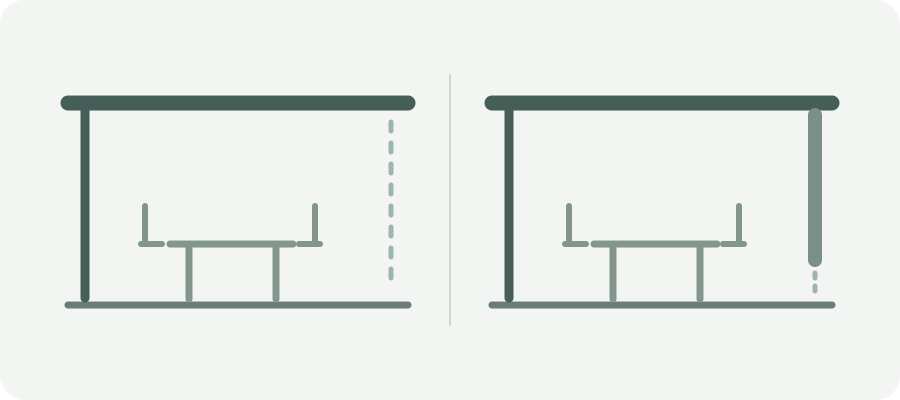
Original geometry sketch, not a flow simulation. It compares enclosure features without ranking seats, measuring pollution or marking a safe zone.
- Overhead cover
A roof remains in both arrangements.
- Side boundary
A screen changes the available side opening.
- Actual use
Smoking and wind still require consideration; the drawing supplies no verdict.
A roof and an open side answer different questions
The roof covers the space above; a wall or lowered screen closes part of the side. Air still has to exchange through the openings that remain. Japanese workplace guidance from 2019 distinguishes roof-only or partly enclosed smoking spaces from fully enclosed ones, and discusses smoke remaining in poorly ventilated spaces or spreading along a roof. These are mechanisms to consider, not a design recipe for a café.
A French field study of terraces in 2008, published in 2011, found different particle pollution in open, partly covered and covered-and-screened configurations. It shows why configuration deserves attention; the groups do not predict the concentration on your terrace or show that every roof has the same effect.
Wind changes the picture while the roof stays the same
A 2007 outdoor particle study examined changing levels near smoking, including wind and source proximity. Outdoor air is not necessarily a uniform mixture: a person can encounter a moving plume even where there is substantial open space. Its measurements were made under particular conditions, not converted into a universal distance rule here.
The number and position of active sources can also change while people come and go. A quiet, breezy moment is a limited observation. It cannot answer what happens later when smoking starts nearer an opening or the wind changes; a breeze you can feel does not measure all smoke constituents.
Worked example: the rain screen comes down
Fictional example: a café describes its roofed terrace as ‘outside’. When you arrive, two sides are open. Rain starts, and staff lower a side screen. People continue smoking under the same roof. The address and terrace label have not changed, but the arrangement through which air can exchange has.
Rather than calculate a new safe seat, ask: ‘Does smoking continue here when the screen is down? Is there a separate smoke-free place we can use?’ If the answer is only ‘this is outdoors’, the questions about the current enclosure and smoking arrangement remain unanswered. You do not need to stay beside smoke to demonstrate them.
Ask about smoking and the connection to indoors
A terrace may also border an open café door or window. Japanese workplace guidance considers smoke travelling along eaves and walls toward building openings; EPA advises keeping outdoor smoking away from openings and air intakes. The space under cover and the adjoining indoor room are therefore two areas the operator may need to consider.
For a visit, ask the operator about the smoking arrangement and available smoke-free alternatives. For a recurring workplace issue, use the responsible facilities or safety contact. A fan or more ventilation does not establish elimination of exposure. Do not move screens, interfere with equipment or redesign a smoking area yourself.
Keep the venue's rule separate from the air question
Whether a covered area counts as indoor or outdoor under a local rule depends on that rule and the actual premises. Ask the operator or appropriate local authority to explain it. Counting open sides yourself cannot certify legal compliance, smoke concentration or health safety.
A useful private message can describe ‘the roofed terrace after the rain screen was lowered’. It need not include photographs of people, names or a record of their smoking. For personal health concerns, contact a qualified local health professional; the diagram and a venue label are not an exposure assessment.
What to keep in mind
Sources
The central claims on this page were checked against the sources below.
- 厚生労働省: 職場における受動喫煙防止のためのガイドライン:屋外喫煙所
Sources checked: 2026-10-04
- Santé publique France / Bulletin épidémiologique hebdomadaire: Tobacco-related air pollution on outdoor patios and inside cafés and restaurants in France in 2008
Sources checked: 2026-10-04
- Klepeis, Ott and Switzer / Journal of the Air & Waste Management Association: Real-time measurement of outdoor tobacco smoke particles (2007)
Sources checked: 2026-10-04
- US Environmental Protection Agency: Secondhand Smoke and Electronic-Cigarette Aerosols
Sources checked: 2026-10-04
General explanation of covered-space features, with a fictional example. Not a site survey, legal classification, seating prescription or individual health assessment.