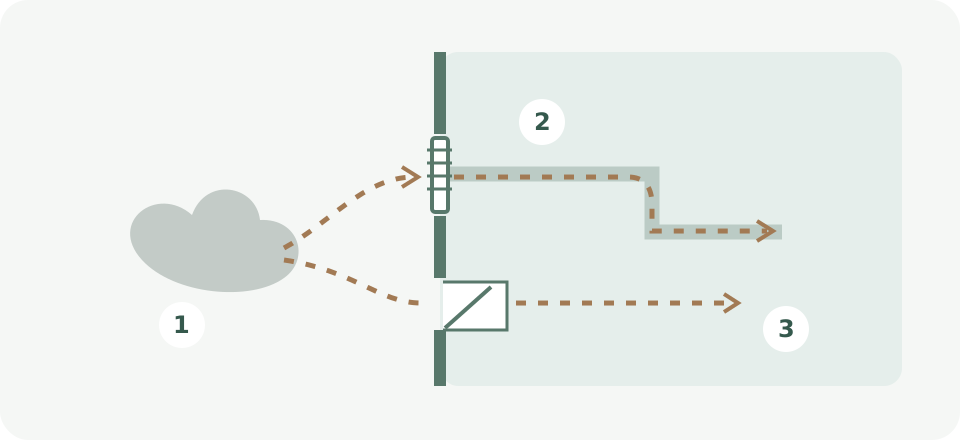
Original conceptual diagram. Dashed arrows mean possible routes, not measured airflow, an identified source, a scale drawing or a safe separation distance.
- 1 · Outdoor area
A possible source zone, not an identified person.
- 2 · Building opening
The upper route represents an outdoor-air intake; the lower route an entrance.
- 3 · Indoor area
The area to describe to the responsible manager; actual connections need checking.
A door opening and an intake do different jobs
A doorway or open window temporarily connects indoor and outdoor air. Japanese workplace guidance specifically considers smoke entering at building openings and travelling along eaves or walls. Being on the other side of a wall is not the same as being separated from the air outside.
An intake brings outdoor air into the building's ventilation system. This differs from an indoor grille, which may supply, return or exhaust air. The grille nearest a smell is not necessarily the outdoor intake; its function and the spaces it serves are questions for the facilities team. The diagram shows two possible connections, not the layout of your building.
Why a route can matter only some of the time
Outdoor-to-indoor transfer depends on the building and its ventilation, openings and surroundings. Wind conditions and the arrangement of roofs or walls also matter. A smoking spot that did not seem to affect the lobby on one visit may connect differently on another; a single calm moment cannot establish that the location always keeps smoke out.
Nor can timing alone establish the route. ‘I noticed tobacco smell in the lobby while the entrance was opening’ is an observation. ‘It must have come through that door from that person’ adds conclusions you have not established. You do not need to keep standing nearby, operate doors repeatedly or follow the smell to make the first report.
Two reports that lead to different questions
Fictional example A: a visitor notices tobacco smell just inside a busy entrance. A useful request is: ‘Could you review the smoking arrangement near this entrance and whether smoke is entering the lobby? Is there another smoke-free waiting place while you look into it?’ This identifies the affected area without prescribing a distance or accusing someone.
Fictional example B: someone notices the smell in an interior meeting room even when they have not seen the entrance open. The question changes: ‘Can the facilities team check which outdoor-air intake serves this room and consider possible outside sources, as well as other routes?’ The observation does not establish that the ventilation system caused it. These are examples of questions, not findings from a building survey.
Ask about the source arrangement before demanding more airflow
EPA advises keeping outdoor smoking away from intakes, doors and open windows; ventilation and filtration can reduce exposure but do not eliminate it. ‘Turn up the fan’ therefore does not answer whether polluted outdoor air is being brought in or whether smoking continues near an opening.
Ask who is responsible for the outdoor smoking arrangement, whether the relevant openings have been considered, and what follow-up will be given. If the reply is only ‘smoking is outside’, explain which indoor area is affected. If it is ‘the filter is working’, ask separately how nearby sources are being addressed. Do not cover a grille, adjust shared fans or dampers, or obstruct a door to investigate.
A building question is not a distance or health verdict
For a home, contact the property manager or landlord; at work, use the facilities or workplace-safety contact; at a venue, ask the operator. A qualified ventilation professional can assess a system that the occupants cannot identify from sight. Keep any note limited to the affected area and broad time pattern, and use the responsible contact rather than posting names, unit numbers or images of people online.
Local smoking rules and technical requirements need checking for the actual location and building. This article cannot turn a separation distance into a guarantee or decide whether an event broke a rule. For a personal health concern, use a qualified local health professional rather than a smell or this diagram to estimate the exposure or its effects.
What to keep in mind
Sources
The central claims on this page were checked against the sources below.
- US Environmental Protection Agency: Secondhand Smoke and Electronic-Cigarette Aerosols
Sources checked: 2026-10-03
- 厚生労働省: 職場における受動喫煙防止のためのガイドライン:屋外喫煙所
Sources checked: 2026-10-03
- Santé publique France: Quelles sont les sources de pollution de l’air intérieur ?
Sources checked: 2026-10-03
- US Environmental Protection Agency: How does outdoor air enter a building?
Sources checked: 2026-10-03
General building-pathway education and fictional reporting examples, not a site inspection, exposure measurement, legal ruling or individual health assessment.