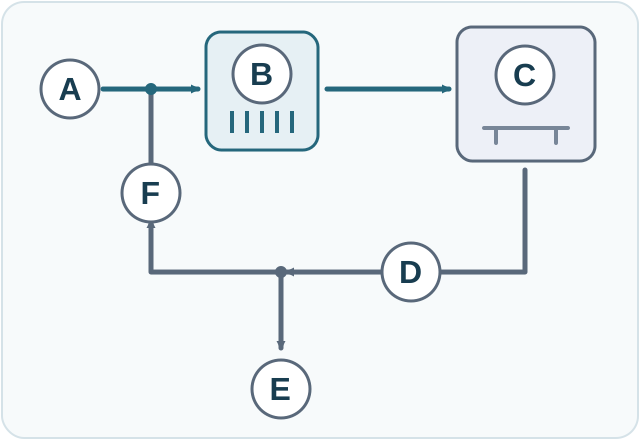
An original simplified functional diagram, not a floor plan or equipment design. Read the arrows with the six labels; the filter’s presence does not mean every pollutant is removed.
- A — Outdoor air
Air enters this example system from outdoors.
- B — Mixing and filtration
Outdoor and reused air meet before passing through the depicted filter.
- C — Supply to the room
The combined air is delivered to the room.
- D — Return from the room
Air leaves the room toward the split.
- E — Exhaust outdoors
This branch leaves the building.
- F — Recirculation
This branch returns to the unit for reuse.
Start at the supply: delivered does not mean all-outdoor
A supply outlet tells you where air enters the room, not its complete origin. ASHRAE’s terminology allows supply air to include outdoor air, recirculated air, transferred air from another space, or a combination. Follow the path upstream to understand what is being supplied.
Cooling and bringing in outdoor air answer different questions. If a unit draws air from the room, cools it and blows it back, that described path is recirculation. Cooler air alone does not show that outdoor air has been introduced.
Return is a starting point, not a final destination
In ASHRAE’s 2019 interpretation, return air is air removed from a space to be recirculated or exhausted. Only the reused part is recirculated air. Exhaust is the path out of the building in the simplified example below.
A return grille therefore does not, by itself, mean that everything entering it goes outdoors. To distinguish the two branches, ask where the return path leads and whether any of that air is supplied again.
A filter answers ‘what is removed?’, not ‘where did the air come from?’
Particle filters and filters designed for particular gases do different jobs. The US EPA explains that air cleaners cannot remove all pollutants; a particle filter is not a general answer to gaseous pollutants. The word ‘filtered’ is incomplete without information about what the device is designed to capture.
Filtration can occur on a recirculating path or alongside an outdoor-air supply. Neither the presence of a filter nor a ventilation system means indoor smoking has been made harmless. EPA’s secondhand-smoke guidance says these methods may reduce exposure but do not eliminate it.
Worked example: a meeting room with a split return path
Fictional example: the building manager explains that air leaves a meeting room through a return path. Some is exhausted outdoors; the rest goes back to the unit, mixes with incoming outdoor air, passes through a filter and is supplied to the room. This is one possible arrangement, not a description of your building.
What can the reader now identify? The air leaving the room is return air. The branch leaving the building is exhaust. The reused branch is recirculation. The supply is the mixed air delivered back to the room. The remaining question is what the fitted filter is designed to remove—not whether the word ‘filter’ proves clean air.
A complete follow-up question is: ‘Could you show me where outdoor air enters this meeting room’s system, which return-air branch goes outside, and which is reused? What does the equipment documentation say the filter captures, and who can explain this route for this room?’
What to keep in mind
Common questions
Can I identify the route just by feeling air at a grille?
Feeling air move does not reveal its source or final destination. Ask the building manager or the qualified person responsible for the system to explain the room’s actual air path using its documentation.
Sources
The central claims on this page were checked against the sources below.
- ASHRAE: Interpretation IC 62.1-2016-7 — June 23, 2019
Sources checked: 2026-10-02
- ASHRAE: ASHRAE Terminology
Sources checked: 2026-10-02
- US Environmental Protection Agency: Secondhand Smoke and Electronic-Cigarette Aerosols — updated 2026-06-09
Sources checked: 2026-10-02
- US Environmental Protection Agency: Guide to Air Cleaners in the Home — updated 2026-10-01
Sources checked: 2026-10-02
A guide to reading air paths, not equipment-adjustment instructions, a building-compliance assessment or a certificate of safe air.