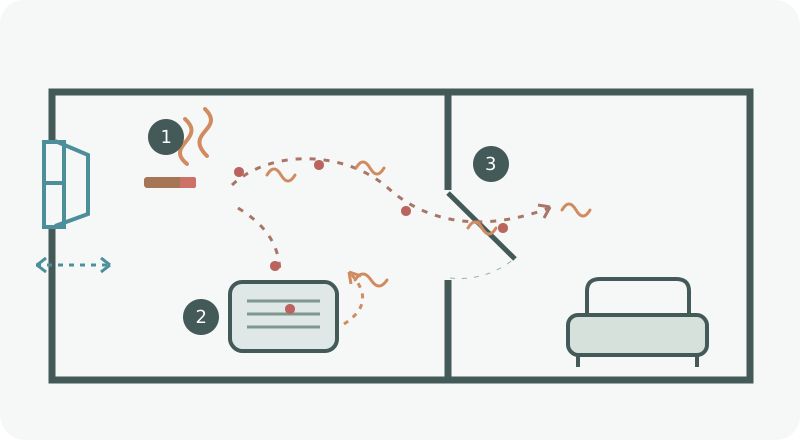
Conceptual routes, not measured airflow, pollutant proportions or a safe room design. The window symbol does not establish the direction of real airflow.
- 1 · Continuing source
Smoking keeps adding a mixture of particles and gases.
- 2 · Local particle capture
Some air may reach the cleaner; particle capture is not complete gas removal.
- 3 · Another route
Smoke can reach an adjoining room without first passing through the device.
A fan, a window and an exhaust are not the same intervention
A circulating fan moves air; it does not itself remove tobacco chemicals. An open window may exchange indoor and outdoor air, but direction and exchange depend on wind and the building. If smoking is beside the window, outdoor air need not be clean.
An exhaust moves air out along a route; a recirculating appliance sends treated air back. The word ventilation alone does not tell which is happening. Air movement can carry smoke to another room. There is no universal window-opening time that certifies a home or car free of smoke.
Particle capture is different from gas removal
Mechanical filters capture airborne particles that pass through them. This does not remove the whole mixture of smoke gases. Devices with sorbent media, such as activated carbon, may remove some gases; performance depends on the chemical, amount of media and its condition, and no single medium removes every gas.
A portable unit is designed for a room or area, not guaranteed treatment of every breathing location. Air that does not reach the device and continuing emissions remain part of the problem. This is a function explanation, not a product ranking, certification guide or particle-monitor clearance test.
Follow the family-room proposal through the doorway
Fictional example: smoking continues in a spare room with a window open and a particle cleaner running. The family sits next door and the smell seems weaker. The cleaner may have changed part of the particle concentration; neither that nor the weaker smell shows that all gases or travel through the doorway have stopped.
The more useful change is a smoke-free indoor and vehicle agreement, including where outdoor smoking might send smoke back through openings. Air cleaning can supplement ordinary indoor-air management after source control; it cannot be used to negotiate a safe amount of indoor smoking. US EPA guidance concerns this physical limit, not the legal status of an individual building.
What to keep in mind
Common questions
If the purifier reduces visible haze, why is that not enough?
Haze describes only a visible part of the mixture. It does not establish removal of gases, smoke elsewhere in the room or exposure during ongoing emissions.
Sources
The central claims on this page were checked against the sources below.
- US EPA: Secondhand tobacco smoke: ventilation and air cleaning reduce but do not eliminate exposure (2026 update)
Sources checked: 2026-10-08
- US EPA: Air cleaners: supplementary control, single-room scope and remaining pollutants
Sources checked: 2026-10-08
- US EPA: Residential air cleaning: particle filtration and gas-phase removal
Sources checked: 2026-10-08
General indoor-air education, without a safe ventilation duration, device recommendation or personal health-risk calculation. Health concerns need qualified care; building arrangements need the responsible local service.