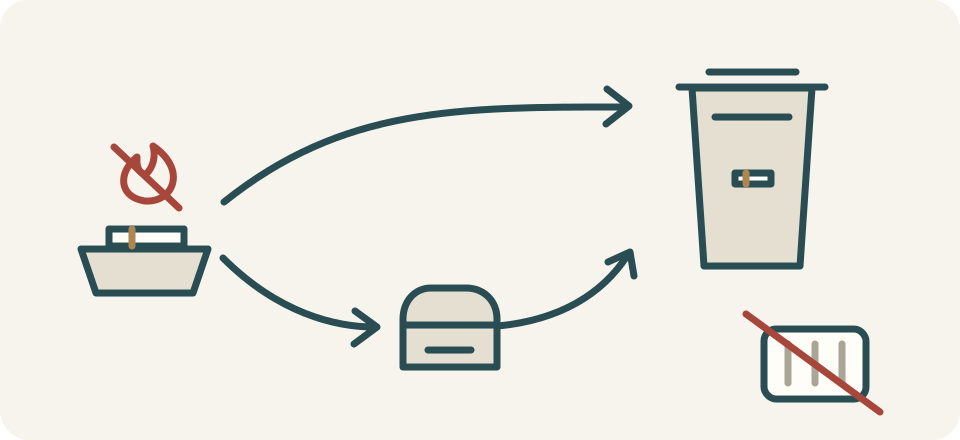
A portable container is an alternative when the appropriate receptacle is unavailable, not a required extra stop. Collection rules come from your local waste service.
- Put it out fully
Extinguishing comes before storage or disposal.
- Use the appropriate route
Use a designated receptacle, or hold the extinguished butt in a pocket ashtray until one is available.
- Keep drains out of the route
A drain is not a cigarette-end receptacle.
Read the waste entry, not just the word ‘plastic’
The DKFZ briefing describes cellulose-acetate filters and pollutants associated with discarded butts. A used cigarette end contains more than an identifiable plastic material; it has also been in contact with tobacco smoke.
Check the municipal entry for ‘cigarette ends’ or ‘cigarette butts’, not a general list of recyclable plastics. A dedicated collection service, if offered, has its own acceptance rules; do not assume the usual plastics bin is that service.
Separate extinguishing from the bin decision
The French environmental agency ADEME explicitly says to extinguish a butt before disposal and describes street receptacles, collective ashtrays and pocket ashtrays. Use that fire precaution first; then follow the collection instructions where you are.
If an appropriate receptacle is not available, a pocket ashtray can hold a fully extinguished butt until one is available. Do not use a street drain as a substitute. Check your council's waste directory for household disposal rather than copying North Herts’ bin color elsewhere.
What the fish experiment actually demonstrated
Slaughter and colleagues prepared cigarette-butt leachate by soaking samples for 24 hours, then observed fish survival over a controlled 96-hour test. Smoked butts with tobacco, smoked filters without tobacco and unused filters were separate test conditions.
This is evidence of toxicity in that laboratory assay, not a universal calculation of how many liters of river water one butt ‘poisons’. Real-world concentrations and exposure pathways are different questions. You do not need that dramatic conversion to keep butts out of streets and drains.
What to keep in mind
Sources
The central claims on this page were checked against the sources below.
- Deutsches Krebsforschungszentrum: Zigarettenkippen – Gift für die Umwelt — 2022
Sources checked: 2026-10-02
- Tobacco Control / PubMed Central: Slaughter et al., Toxicity of cigarette butts, and their chemical components, to marine and freshwater fish — Tobacco Control, May 2011; DOI 10.1136/tc.2010.040170
Sources checked: 2026-10-02
- North Herts Council, United Kingdom: What goes in each bin — updated 2026-09-17
Sources checked: 2026-10-02
- ADEME, France: Que faire de mon mégot de cigarette ? — mise à jour 2026-10-01
Sources checked: 2026-10-02
General waste and environmental education. Named collection examples are local; the fish assay is not a human-dose or field-water safety calculation. No universal decomposition time or bin color is supplied.