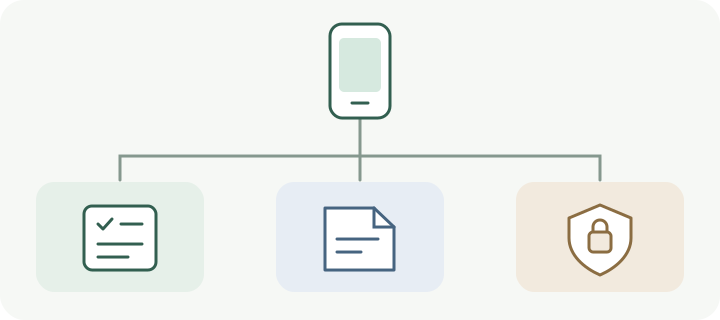
Concept diagram, not a product assessment or trial result. The branches are independent.
- Capability
Can the described task be inspected and controlled?
- Evidence
Which version, comparison and smoking assessment were studied?
- Privacy
What leaves the device, to whom, and how can it be removed?
Start with the task you can actually inspect
Invented example: one app lets a person write a private note and turn reminders off; another displays a streak and shares it publicly by default. Inspect the task, settings and disclosure separately. A streak is a value calculated from entries, not a biological assessment or a forecast of relapse. A library can provide reading without having tested an abstinence outcome.
Keep new findings attached to their comparison
WHO 2024 gives a conditional digital-support recommendation, with low certainty for apps. Apps versus minimal intervention did not establish a clear long-term difference in its synthesis. Other comparisons—more versus fewer functions, or an app added to pharmacotherapy—had favourable findings; those are different study packages, not proof that adding any feature helps. Text-message evidence cannot simply be assigned to apps.
A 2026 review searched through 15 August 2025. Four studies with 1,402 participants suggested apps alone versus no/minimal support may improve six-month continuous abstinence: RR 2.85 (95% CI 1.61–5.05), low certainty. It included current smokers aged at least 15 who intended to quit, not all app users. This is a relative group result, not a 285% personal chance, and is not advice for minors. The authors call the findings exploratory. Trials of specific versions and arrangements do not validate every store listing or the latest update.
Follow a note from screen to recipient
The WHO assessment asks about effectiveness and separately about privacy, security, technical requirements, advertisements and outside resources. For your own inspection, ask: does the note remain on this device, go to a provider's server, enter a backup, or become visible to other users? ‘No account’ alone does not answer these questions.
Read current policy and settings for collection, recipients, retention, deletion and optional sharing. Check permissions against the described function. If a route is unclear, mark it unknown rather than assuming local-only storage. Try a demonstration without entering smoking history; private notes do not belong in public posts or share links.
An assessment invitation is not a product endorsement
WHO's page describes developer self-assessment followed by expert review and a decision. Merely using that checklist or applying is not proof of approval. For any certification claim, retain issuer, jurisdiction, exact product/version, intended use and current original decision. Do not infer medical-device status from a download button or clinician-authored content.
This article ranks no products and recommends no personal treatment. Qualified local professionals can discuss support; in England, NHS Better Health links to local services. An app's recording task should not replace requested professional help, diagnose a condition or promise relief from withdrawal.
What to keep in mind
Sources
The central claims on this page were checked against the sources below.
- World Health Organization: WHO adult cessation guideline (2024), §3.2: apps and separate comparisons
Sources checked: 2026-10-05
- World Health Organization: Tobacco cessation mobile app assessment: content, effectiveness, certification and privacy
Sources checked: 2026-10-05
- BMJ Evidence-Based Medicine / PubMed: Apps alone or with traditional interventions (2026), primary abstract; search 15 August 2025
Sources checked: 2026-10-05
- NHS Better Health: Ready to quit smoking — local support in England
Sources checked: 2026-10-05
General evidence reading, checked 5 October 2026. Interface example fictional; no product endorsement, personal treatment, diagnosis or outcome guarantee.